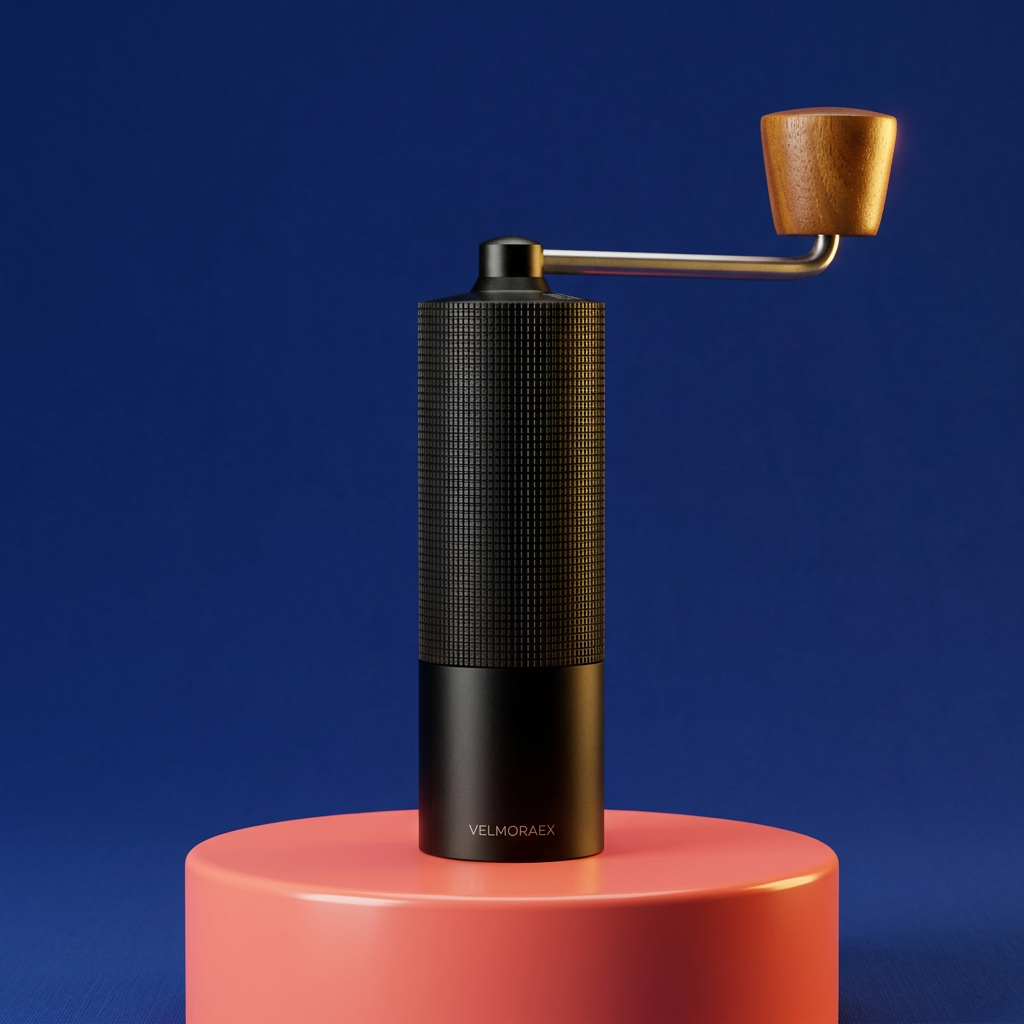
Velmoraex Premium Manual Coffee Grinder with Textured Black Body, Silver-Tone Hand Crank & Wood-Tone Knob for a Hands-On Coffee Ritual
Velmoraex Premium Manual Coffee Grinder with Textured Black Body, Silver-Tone Hand Crank & Wood-Tone Knob for a Hands-On Coffee Ritual
Couldn't load pickup availability

Velmoraex Premium Manual Coffee Grinder with Textured Black Body, Silver-Tone Hand Crank & Wood-Tone Knob for a Hands-On Coffee Ritual
🫘 Before the First Sip, There Is a Moment Worth Keeping
Choose the beans. Set out the cup. Turn the handle. The Velmoraex Premium Manual Coffee Grinder makes preparation part of the experience, not simply something to get through before the coffee is ready.
Its tall black cylindrical body pairs a finely textured upper section with a smooth lower section. Above it, a silver-tone crank extends outward to a warm wood-tone knob. The contrast is direct and deliberate: dark texture, a bright mechanical line and a touch of natural-looking warmth at the point where your hand meets the handle.
This is coffee preparation with your own pace built into it. The manual format needs no electric motor to turn the mechanism. You supply the movement, making the grinder a tactile part of the routine rather than another appliance running in the background.
🌀 The Pleasure Is in Taking Part
A hand grinder asks you to be present. One hand steadies the body while the other works the crank according to the supplied instructions. The visible textures, the position of the handle and the repeated motion make preparation feel more connected to the cup you are about to brew.
There is no need to dress that up as a guaranteed improvement in flavor. Good coffee depends on more than a grinder. Beans, recipe, water, brewing equipment and technique all play a role. What this format offers is a hands-on way to perform one important step yourself.
If you enjoy the process as much as the finished drink, that small interval can become a welcome part of your morning.
🧱 Three Contrasts That Define the Design
Textured Above, Smooth Below
The upper body carries a fine grid-like pattern, giving your hand a textured area to hold. The lower section is visually quieter, with a smooth black finish and a clear horizontal meeting line between the two areas. The result is a practical-looking silhouette with detail where you notice it most closely.
A Silver Line Against a Dark Cylinder
The crank stretches outward from the black top spindle before bending upward toward the knob. That bright horizontal line changes the appearance of an otherwise simple cylinder, making the manual mechanism part of the product's visual character.
A Warmer Detail at the End of the Handle
The wood-tone knob adds contrast in both color and texture. Its rounded shape is distinct from the narrow crank and finely patterned body. Actual wood species, coatings and material specifications should be confirmed from the supplied product details rather than inferred from the image.
Velmoraex keeps the branding understated, leaving the black, silver-tone and wood-tone combination as the main visual identity.
✍️ A Grinding Journal: From Whole Beans to a Finished Cup
Entry One: Decide What You Are Brewing
Begin with the brewing equipment and recipe you intend to use. Confirm that the actual grinder supports the grind range required by that method. A manual grinder should not automatically be assumed to handle every preparation from very fine espresso to coarse immersion brewing.
If the supplied model includes adjustment, use its documented procedure and recommended starting points. Exact settings, click counts and adjustment location are not established by the reference photograph.
Entry Two: Prepare a Measured Portion
Use a suitable quantity of whole roasted coffee beans within the model's stated capacity. A separate scale can help you follow a recipe, but it is not represented as an included accessory. Do not estimate hopper or collection capacity from the grinder's height in a product image.
Load only as directed. The visible top and lower-body seam do not establish which parts are removable or how they open.
Entry Three: Turn with a Steady Rhythm
Hold the textured body securely and operate the crank in the direction and manner described in the instructions. Let the mechanism work without forcing it. If resistance changes unexpectedly or the handle jams, stop and follow the recommended troubleshooting guidance.
Grinding effort and duration can vary with the beans, supported setting and quantity. No fixed grinding time, effortless operation or silent performance is promised.
Entry Four: Transfer, Brew and Notice
Follow the approved procedure for accessing and transferring the grounds, then prepare your coffee with your chosen brewing equipment. Notice what you enjoy about the finished cup, and record the recipe rather than changing everything at once.
The grinder prepares coffee grounds; it does not brew, heat water or provide a finished drink on its own.
🧪 Keep the Experiment Simple
A personal coffee routine becomes easier to understand when you change one thing at a time. Keep a short note of the beans, portion, supported grinder setting and brewing recipe. If you later adjust a variable, you have a clearer point of comparison.
- Keep the beans identifiable: Record which coffee you used instead of relying on memory after switching between bags.
- Measure consistently: Follow the quantities in your chosen recipe and remain within the grinder's limits.
- Use documented adjustments only: Do not force a control beyond its supported range or assume a click value from another model.
- Separate grinding from brewing decisions: Keep the rest of the recipe steady while learning how an approved adjustment affects your process.
- Write down the result: A few words about your preference are more useful than chasing a universal description of the perfect cup.
These are preparation habits, not guarantees of uniform particle size, extraction performance or professional espresso results.
🧭 A Manual Tool with Its Own Place in the Day
At the kitchen counter: Set it beside your brewing area so the sequence feels natural: beans, grinder, brewer, cup. The black body works as a neutral anchor among colorful ceramics and wood surfaces.
At the weekend coffee table: A slower morning can make room for hands-on preparation. Use a stable, suitable workspace and keep grounds away from soft furnishings and places where they could spill.
In a more flexible coffee setup: A manual mechanism does not require a power outlet for grinding. Before planning transport, check actual dimensions, weight and the approved way to secure the crank. Do not assume the handle folds or detaches, or that a travel case is included.
🟫 Build a Coffee Corner Around Contrast
Emerald tile and a coral cup give the black cylinder a confident setting. Terracotta and navy offer a warmer, more grounded palette. Mint, lilac and pale yellow make the silver-tone crank a sharper graphic detail, while the wood-tone knob connects naturally with a walnut tabletop.
Keep the arrangement useful. Leave room to turn the crank and transfer the grounds without reaching around decorative objects. A cup, a brewer and a small clear working area can be enough. The best setup is one you can use comfortably, not just photograph once.
Brewers, cups, coffee beans, dishes and other gallery props illustrate possible settings and are not represented as included accessories.
🧹 Care for the Mechanism, Not Just the Exterior
Follow the manufacturer's cleaning schedule and approved cleaning method. Coffee residue deserves attention, but not every grinder component should be washed with water. Do not immerse the assembled grinder, place it in a dishwasher or wet internal parts unless the supplied instructions explicitly permit it.
Disassemble only the parts the manual identifies, and keep track of their order and orientation. Use approved tools rather than sharp objects, abrasive cleaners or improvised lubricants. Reassemble and confirm correct operation before adding another portion of beans.
Use the grinder only for the ingredients it supports. Do not assume it is suitable for nuts, spices, sugar or other foods, and keep fingers clear of moving or cutting components. If the mechanism is damaged or repeatedly jams, stop using it and follow the manufacturer's support guidance.
🧾 What to Check Before It Joins Your Routine
What are the grinding components made from?
The internal mechanism is not visible in the reference. Burr construction, material, size and bearing specifications require confirmation from the actual model's documentation.
Is the grind adjustable?
The photograph does not establish an adjustment system or the number of settings. Use only documented controls and supported ranges.
Can it grind for espresso?
Espresso suitability is not promised. Confirm the actual grind range and intended brewing applications before pairing it with an espresso machine.
How much coffee does it hold?
Hopper and grounds-section capacities cannot be established from the image. Check the supplied specifications and do not overfill.
Is it completely quiet?
No. Manual operation avoids an electric grinding motor, but grinding itself can still produce sound.
Does it include a brush, pouch or spare parts?
Only the confirmed package contents should be treated as included. No cleaning tool, storage bag or replacement component is assumed here.
🌄 Make the Preparation Part of the Reward
There is a different satisfaction in a cup you have taken time to prepare. Not because every step must be complicated, but because a familiar sequence can become something you genuinely enjoy.
Choose the Velmoraex Premium Manual Coffee Grinder for its hands-on format, textured black body and distinctive crank-and-knob design. Check the supported specifications, follow the operating guidance and give the moments before your coffee a little more attention.